Heat tells you first.
Calibrated thermal imaging and edge AI for farms. Barn climate, crop water stress and electrical fire risk — measured on site, every minute.
Book an assessment See the use cases
Every claim on this site carries an evidence grade. What that means
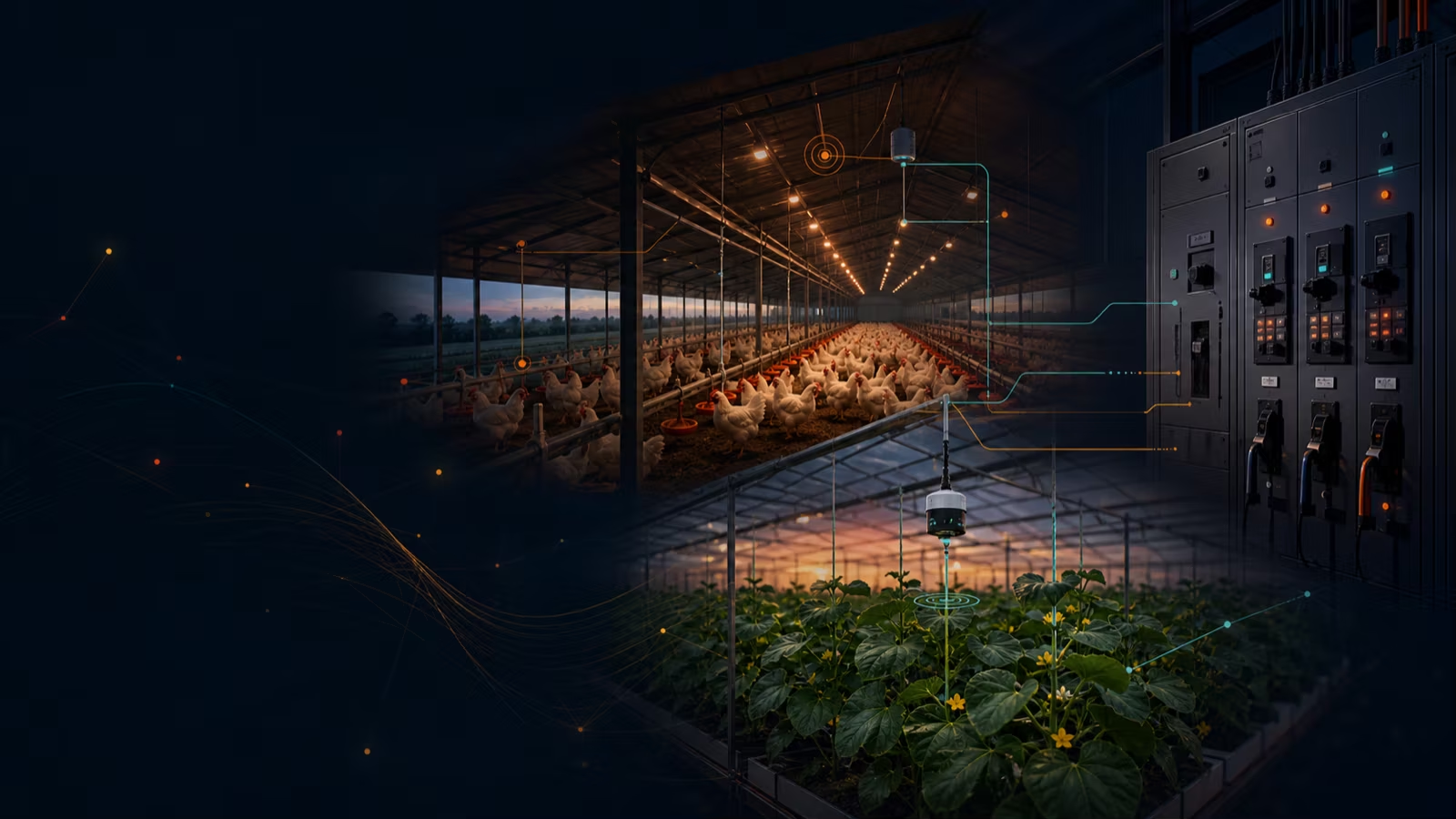
Three measurements
Three numbers. Three reasons calibration is the product.
The problem
A farm has one thermometer and a thousand temperatures.
-
Buildings
Barn climate is not uniform. In a commercial house, the maximum internal temperature difference grew from 1.85 °C to 6.43 °C as the birds aged.
Deng et al. 2024, Animals 14(18):2638 -
Crops
Canopy temperature reveals stomatal closure before a leaf wilts. A soil probe measures one point. A field is not one point.
-
Equipment
A loose connection heats up weeks before it arcs. Belgium recorded 143 barn fires between 2006 and 2011. Animals died in 62 of them — 192,862 in total.
Dutch Association of Insurers / Flemish Parliament records
Measured, not estimated
We measure temperature. Most farm cameras estimate it.
Every scaled livestock vision platform we could verify runs on RGB video, wearables or boluses. One of the largest infers temperature from visible light using machine learning. Inference is not measurement.
| Specification | Typical farm camera | Hypera Agri |
|---|---|---|
| Sensor | RGB, visible light | Radiometric thermal, plus RGB |
| Temperature | Estimated by model | Measured per pixel |
| Reference | None | On-frame reference surface |
| Air temperature | Nearest weather station | Co-located sensor at the camera |
| Processing | Cloud | On-site edge inference |
| Claims | Marketing grade | Evidence grade, published |
Where it applies
Three domains. One sensor stack.
-
Livestock
Heat stress, house climate, condition monitoring. Cattle and poultry.
-
Crops & Greenhouse
Water stress, climate uniformity, condensation risk.
-
Farm Infrastructure
Electrical fire risk, motors, solar arrays, stores.
How it works
Measure. Explain. Act.
-
Capture
Radiometric cameras plus a co-located air temperature and humidity reference. Per-pixel °C, not a colour picture.
-
Calibrate
Emissivity, distance, angle and ambient compensation applied at the edge. Uncalibrated low-cost sensors have shown 9.29 °C error. With a controlled reference, 1.01 °C.
arXiv:2405.19413 -
Infer
Models run on site. Segmentation isolates the animal, the canopy or the panel from everything else in frame. No video leaves the farm.
-
Act
Thresholds, trends and alerts routed to the person who can fix it. Ranked by cost, not by pixel count.
Evidence method
Some of this is proven. Some of it is not. We label which.
Thermal imaging in agriculture ranges from independently replicated science to actively contested claims. We publish the grade beside every use case, with the study behind it.
Replicated peer-reviewed research, or mature practice in an adjacent industry. The source line says which.
Example: forehead temperature tracks THI at r = 0.808 in dairy cattle, N = 488.
Real published results from small samples, single sites or lab conditions. Sample size always shown.
Example: over 81% accuracy on digital dermatitis at first clinical signs. 38 animals, one farm.
Mechanistically plausible, not yet supported by field evidence. Run as research, priced as research.
We put no performance number on this website for anything at this grade.
Start with a measurement, not a subscription.
A fixed-fee assessment. One day on your site. A written report with the thermal evidence, the cost of what we found, and a verdict — deploy or stop.